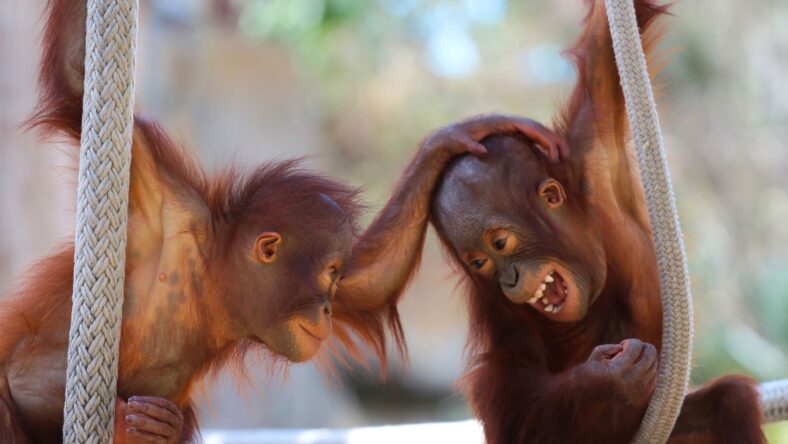
As kids, we mastered the art of teasing and bothering our siblings throughout childhood. But, according to a new study, this habit might have a much longer history than we previously thought.
Researchers observing four species of primates found that young apes are just as skilled at pestering as humans, indicating that our knack for being annoying is a trait shared with our nearest relatives.
In a study published in Proceedings of the Royal Society B, the researchers proposed that this behavior demonstrates an intricate grasp of emotions and social conventions. They also believe it laid the groundwork for the development of humor as we recognize it today.
“The precursors of joking were there in the last common ancestor 13 million years ago,” said Erica Cartmill, the study’s co-author.
To gain a deeper understanding of the role of playful teasing in social interactions, the research team scrutinized 75 hours of video recordings from great ape enclosures at the San Diego Zoo and Leipzig Zoo. In their study, they documented 142 distinct instances of teasing observed across nine bonobos, four orangutans, four gorillas, and 17 chimpanzees.
Then, the scientists identified 18 specific types of playful mischief. These included hiding, body slamming, obstructing activity, hitting, impeding movement, striking with an object, and offering and retracting a body part.
Additionally, presenting and withdrawing an object or body part, poking, prodding with an object, tugging on a body part, pulling hair, stealing, swinging an object, tickling, engaging in tug of war, and encroaching on personal space.
Now, this list might just remind you of a typical day at home with your little ones. If so, there’s likely an evolutionary explanation for it. The team pointed out the striking resemblance of these actions to human behavior.
“What’s interesting is we found similarities with human infant teasing. When human infants tease their mother, they tend to look at their mother’s face for a reaction. We see that in these great apes, too,” explained Isabelle Laumer, the study’s lead author.
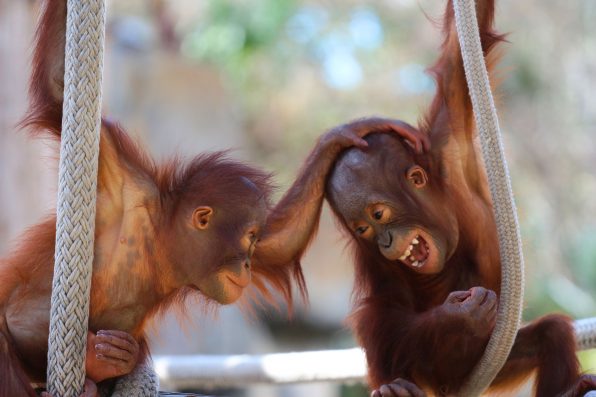
Plus, the researchers observed that different species showed a liking for certain types of pranks. Chimpanzees were fond of slapping adults who were dozing off, while orangutans had a particular penchant for hair-pulling. Additionally, gorillas typically opted for a straightforward approach by pushing others.
Mirroring human behavior, the majority of the interactions observed across the four species typically involved a younger ape repeatedly pestering an older one, aiming to elicit a reaction.
Then, when their initial attempts failed, the apes intensified their antics to provoke a response. Oftentimes, this resulted in the older ape engaging in reciprocal teasing. Tickling and stealing were common comebacks among the adults, in contrast to more aggressive actions like hitting or body slamming.
This suggests that the humor we find familiar as humans is also present in apes. In other words, in order for teasing to be successful– involving both instigation and a response– it requires at least some level of willingness from both parties involved.
According to Marina Davila-Ross, a communication evolution researcher who was not part of the study, teasing is often linked to humor, but it also plays a role in understanding social dynamics.
For example, when a young ape teases another and doesn’t receive a response, it informs the teaser about the limits of their interaction with the other individual.
This is crucial for learning about social integration and hierarchy formation within their group.
Inside jokes, playful teasing, and even flirtation are all typical ways in which humans use teasing positively in social settings.
So, although the researchers refrained from making assumptions about the exact reasons behind the apes’ teasing behaviors, their observations imply that such actions serve a social purpose in ape communities.
Additionally, these findings hint at a shared ancestral link between apes and humans, one that likely had a fondness for a bit of mischief.
To read the study’s complete findings, visit the link here.
Sign up for Chip Chick’s newsletter and get stories like this delivered to your inbox.

By Katharina Buczek
Katharina Buczek graduated from Stony Brook University with a degree in Journalism and a minor in Digital Arts. Specializing in... More about Katharina Buczek