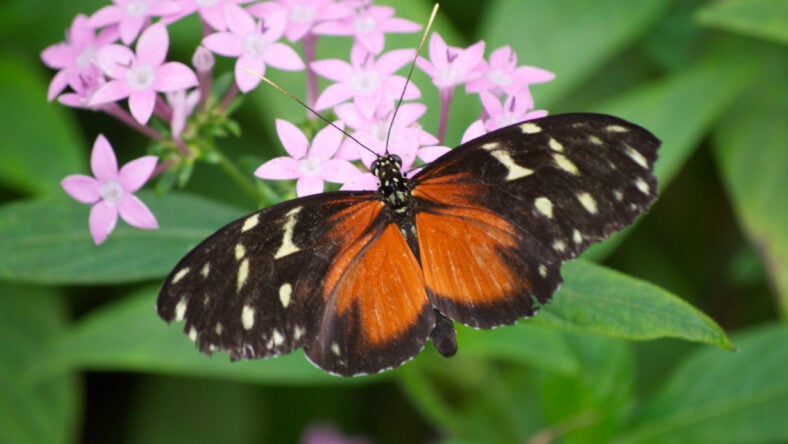
Once a butterfly emerges from its chrysalis, it usually flies around for a few weeks before dying. However, some species of tropical butterfly can live for up to almost a year, making them much older than their closest relatives.
Butterflies of the Heliconius genus are found in the tropical rainforests of South and Central America. They have evolved unique mechanisms to extend their lifespans.
Although researchers aren’t exactly sure how these mechanisms work, the new findings could provide insight into how to delay aging for other animals, including humans.
On average, Heliconius butterflies live around three times longer than their closest relatives. Heliconius hewitsoni has been observed to reach a maximum lifespan of 348 days, while its close relative, Dione juno, only lived up to 14 days.
“A lot of people have known—at least within the Heliconius community and also in the broader insect longevity community—that these butterflies could live for up to six months,” said Jessica Foley, the co-author of the study and a researcher at Tufts University.
The unusual diet of the species may be what contributes to their long lives. The adult butterflies can feed on pollen, which is rare to see because most butterfly species rely on flower nectar as their source of sustenance. According to Foley, pollen contains lipids and amino acids, while nectar is essentially just sugar water.
The research team conducted an investigation into the effects of diet on the longevity of a pollen-feeding species, Heliconius hecale, and a non-pollen-feeding relative, Dryas iulia. The former has been reported to live up to 104 days, and the latter up to 68 days.
The researchers studied 96 individuals of H. hecale and 116 individuals of D. iulia. Butterflies from each group were either fed or withheld pollen.
Over the course of several weeks, the H. hecale butterflies that were deprived of pollen showed a steeper decline in body mass than those that got to consume pollen.
Even when deprived of pollen, H. hecale still lived longer than D. iulia. Feeding pollen to D. iulia also did not affect its lifespan. The results of the study suggest that both diet and evolutionary factors contribute to H. hecale’s lifespan.
Additionally, the team came up with a test to measure age-related muscle decline in the butterflies. They lined a perch with sandpaper and attached the perch to a wooden base.
Then, they placed everything on a balance scale. They held the butterflies by their wings next to the perch until the insects latched on.
Afterward, they tugged on the butterflies until they released their grasp on the perch, causing the balance to drop. Finally, the researchers used the reading on the scale to determine how much weight the butterflies could hold before letting go.
In D. iulia, grip strength weakened with age, but not in H. hecale. The pollen-deprived H. hecale were weaker than the pollen-fed group.
“The exciting implication of this lifespan extension is that it provides a powerful opportunity to identify the mechanisms that underpin longevity,” said Foley.
“By comparing long-lived Heliconius butterflies with their short-lived relatives, we have a natural evolutionary experiment that can help reveal how lifespan is extended, making them a highly promising new model for research into the biology of aging and longevity.”
The research was published in Nature Communications.
Sign up for Chip Chick’s newsletter and get stories like this delivered to your inbox.

By Emily Chan
Emily Chan is a writer who covers lifestyle and news content. She graduated from Michigan State University with a degree in... More about Emily Chan