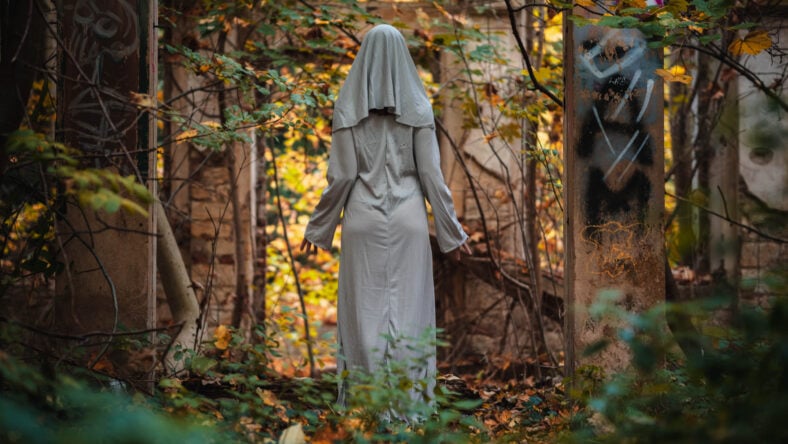
On August 11, 1676, a 31-year-old nun named Sister Maria Crocifissa della Concezione was found on the floor of her room in the convent of Palma di Montechiaro in Sicily.
She had fainted, her face was covered in ink, and she was holding several pieces of paper filled with random letters and symbols.
Sister Maria claimed that the letter was written by the devil, who was trying to lead her away from God and toward evil. Only one of her letters managed to survive over the years.
It contained 14 lines of unintelligible scribbles. For centuries, experts have attempted to decipher the scribbles, but have been unsuccessful.
Sister Maria Crocifissa della Concezione was born Isabella Tomasi. She was an ancestor of an Italian writer named Giuseppe Tomasi di Lampedusa. When she was 15 years old, she entered the convent, according to historical records.
The mysterious letter appeared to be written in a sort of shorthand. Researchers from the LUDUM science museum in Sicily believed that Sister Maria may have invented a new vocabulary using ancient alphabets and decided to take a crack at decoding the infamous letter.
First, they tested a code-breaking software found on the dark web by using standard shorthand symbols from different languages.
They primed the software’s algorithm with ancient Greek, Latin, and Arabic, as well as the Runic alphabet. Then, they ran Sister Maria’s letter through it.
They did not have high hopes for the results, but Sister Maria was a skilled linguist, and the message came out making more sense than they initially predicted. The letter turned out to be made up of a jumble of languages written by Sister Maria herself.
Sign up for Chip Chick’s newsletter and get stories like this delivered to your inbox.
In the letter, Sister Maria called the Holy Trinity “dead weights” and that the basic principles of Catholicism “works for no one.” The letter suggests that the nun suffered from schizophrenia or bipolar disorder.
“I personally believe that the nun had a good command of languages, which allowed her to invent the code and may have suffered from a condition like schizophrenia, which made her imagine dialogues with the devil,” said Daniele Abete from the LUDUM group, who led the decoding effort.
Historical records described how Sister Maria screamed and fought against the devil every night. Back in the day, the image of the devil typically came up when dealing with mental illnesses.
At that time, the letter was viewed as Sister Maria’s struggle against evil spirits, not a symptom of a disorder.
Abbess Maria Serifica wrote an account of Sister Maria’s behavior shortly after the incident occurred. Apparently, the devil tried to force Sister Maria to sign the letter, but she bravely refused his demands and instead wrote, “Ohimé (oh me). She was later blessed for her courage.

By Emily Chan
Emily Chan is a writer who covers lifestyle and news content. She graduated from Michigan State University with a degree in... More about Emily Chan