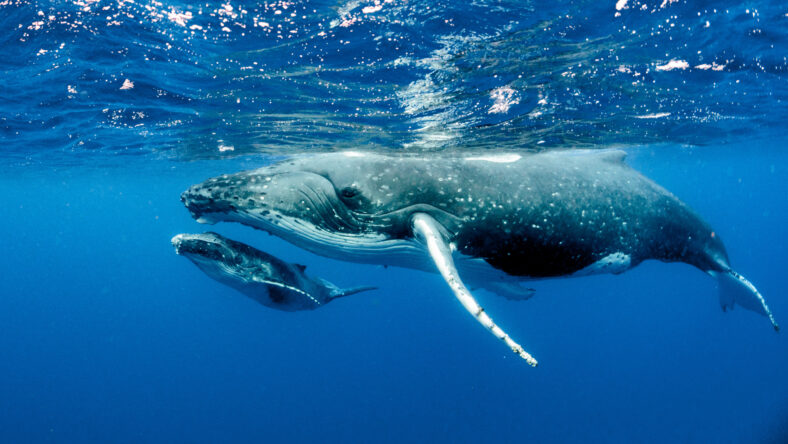
Whales returning to the warming waters of the Gulf of St. Lawrence for the summer are sharing more food resources. The shift in diets is caused by climate change, affecting the kinds of prey fish available.
The Gulf of St. Lawrence is one of the most important whale feeding grounds in the North Atlantic. Multiple whale species stop there each summer to replenish themselves. But as the waters warm, ice cover is dwindling, and prey is becoming less predictable.
A new study has suggested that fin, minke, and humpback whales are adjusting to their changing environment by sharing food.
For instance, fin whales typically feast on Arctic krill, which is a key part of their diet. Lately, Arctic krill has been lacking, so fin whales and minke whales are turning to capelin, herring, and mackerel, the primary diet of humpback whales.
“Our study shows that whale species are able to adjust their diet to varying availability of preferred prey,” said Charlotte Tessier-Larivière, the first author of the study from the Université du Québec à Rimouski.
“This is positive, as it shows a certain capacity to adapt—but we don’t know the full extent of their adaptive capacity.”
The findings draw on a 28-year study that tracked whale diets in the Gulf of St. Lawrence. Researchers took tissue samples collected from fin, minke, and humpback whales between 1992 and 2019. They analyzed the samples for carbon and nitrogen isotope signatures to piece together feeding patterns.
All three whale species showed a steady shift away from krill and toward forage fish, such as capelin, herring, and mackerel. Despite the fact that they are now eating the same food, they were not stealing from each other. Instead, they were sharing a limited supply of resources.
The whales may be eating the same fish, but they also seem to have less food overlap in recent years, indicating that they are targeting different species of fish at different times or places.
Sign up for Chip Chick’s newsletter and get stories like this delivered to your inbox.
In the early 2000s, the whales’ food overlap was much more prevalent. Minke whales overlapped with fin and humpback whales by about 65%.
Humpback whales overlapped with minke whales by roughly 56%, and fin whales overlapped with minkes by approximately 42%.
During the 2010s, food overlap declined. The overlap dropped to 47% between minkes and the other two whale species. Humpback whales’ overlap with minkes fell to about 9%, while fin whales’ overlap with minkes reduced to 29%. Humpback and fin whales did not overlap at all.
The whales appeared to be divvying up resources in a way that avoids direct competition by feeding on different prey in different areas or at different times.
“This ecosystem seems sufficiently productive and offers alternative prey that are partitioned across space and time,” said Tessier-Larivière.
“These conditions promote coexistence rather than one species outcompeting and excluding the others.”
The study was published in Frontiers in Marine Science.

By Emily Chan
Emily Chan is a writer who covers lifestyle and news content. She graduated from Michigan State University with a degree in... More about Emily Chan