On a Swedish island, a rare cemetery from the Stone Age reveals the family relationships of the last hunter-gatherers in Europe. Some people were buried with distant relatives instead of close ones, demonstrating that relationships outside of the immediate family were important in their community.
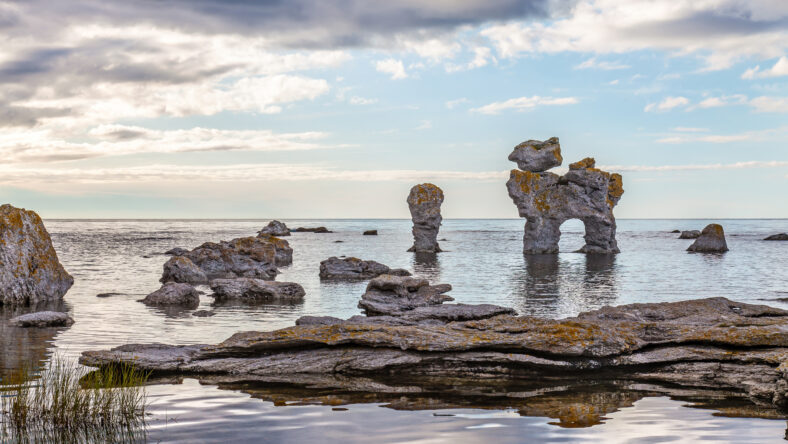
The site, Ajvide, is located on the western Swedish island of Gotland. It was first excavated in 1983 and has since yielded 85 graves from the Pitted Ware culture, a hunter-gatherer society that existed in the area 5,500 years ago.
They lived in Scandinavia and mainly supported themselves by hunting seals and fishing, even though agriculture had been spreading across Europe at that time.
Ajvide was occupied for at least four centuries. Archaeologists have found well-preserved graves, pottery pieces, and animal bones. Eight of the graves contained more than one individual.
At first, it was assumed that the people buried together were closely related, but after conducting DNA analysis, researchers were able to fully investigate the relationships in the Ajvide cemetery.
“Surprisingly enough, the analysis showed that many of those who were buried together were second or third degree relatives rather than first-degree relatives—in other words, parent and child or siblings—as is often assumed,” said archaeogeneticist Helena Malmström.
“This suggests that these people had a good knowledge of their family lineages and that relationships beyond the immediate family played an important role.”
In one grave, an adult female skeleton was excavated with two children lying on either side of her, one boy and one girl. The woman was about 20 years old, and the children were four and one and a half.
DNA analysis showed that the children were full siblings. The woman was not their mother. She was most likely their father’s sister or half-sister.
Sign up for Chip Chick’s newsletter and get stories like this delivered to your inbox.
A young individual was discovered in a second grave, along with the remains of an adult man. The individual, a teenage girl, was buried on her back.
Her father’s bones were placed on top of her and next to her. He died before her, and his remains had probably been moved to the grave from somewhere else.
Another grave contained the skeletons of a boy and a girl. They were third-degree relatives who shared one-eighth of their DNA and were most likely cousins. Finally, a fourth grave held another pair of third-degree relatives, either cousins or a great-aunt and great-niece.
It is the first time that researchers have conducted such an in-depth study of family relationships among Scandinavian hunter-gatherers in the Neolithic period.
They will continue analyzing the remains of more than 70 individuals from the Ajvide cemetery to learn more about the history, social structure, and burial practices of ancient hunter-gatherers.
The findings were published in Proceedings of the Royal Society B.

By Emily Chan
Emily Chan is a writer who covers lifestyle and news content. She graduated from Michigan State University with a degree in... More about Emily Chan