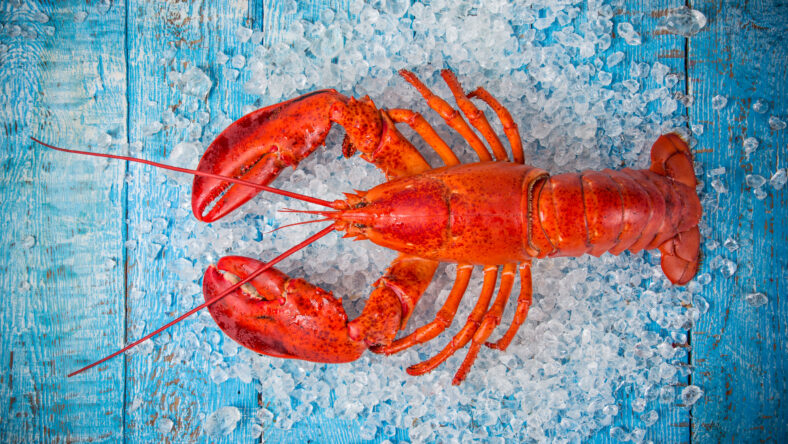
Scientists have long suspected that lobsters have the ability to feel pain. A new study on Norway lobsters has confirmed that the crustaceans seem to respond to electrical shocks with emotional distress and that boiling them alive causes them pain and suffering.
A team of researchers from the University of Gothenburg in Sweden found that two drugs used as pain relievers for humans, aspirin and lidocaine, helped reduce pain responses when receiving electric shocks.
They believe that when lobsters rapidly flip their tails, the behavior is not just a simple reaction to stress, but a pain reflex.
“The fact that painkillers developed for humans also work on Norway lobsters shows how similar we function,” said Lynne Sneddon, a professor of zoophysiology at the University of Gothenburg.
“That’s why it’s important to care about how we treat and kill crustaceans, just as we do with chickens and cows.”
The act of boiling live crustaceans has already been banned in Norway, New Zealand, Austria, and some areas of Australia. In the United Kingdom, similar laws are being proposed to protect lobsters. Furthermore, electrically stunning lobsters and crabs is being explored as a more humane alternative to boiling them alive.
For the study, the research team wanted to better understand how lobsters respond to pain, so they divided 105 Norway lobsters into several groups. Two groups received electric shocks and were treated with aspirin or lidocaine, while another wasn’t given any medication.
The control groups weren’t shocked at all. The aspirin was injected directly into the lobsters, while the lidocaine was dissolved in each lobster’s tank.
The researchers gave a 9.09-volt-per-meter electrical shock for 10 seconds and observed the lobsters’ behavior before, during, and up to two hours after the shock.
Sign up for Chip Chick’s newsletter and get stories like this delivered to your inbox.
The shocked lobsters tried to use a tail flip to escape. It’s common for some crustaceans to perform this maneuver, as it helps launch them out of danger. The tail flips were not seen in the control groups.
The number of tail flips dropped when the lobsters received aspirin or lidocaine. Only three of the 13 lobsters treated with aspirin and seven of the 13 lobsters treated with lidocaine did a tail flip. Responses were more intense in the untreated group.
Overall, the results suggested that the electrical shocks were causing the lobsters pain. The tail flip may have had a neurological component called nociception, which is when harmful stimuli are detected by the body and pain signals are sent to the brain, triggering a negative internal state associated with pain.
In the past, other studies have indicated that creatures like octopuses and other invertebrates can feel pain. The latest findings on lobsters add to a growing amount of evidence about pain processing.
The study was published in Scientific Reports.

By Emily Chan
Emily Chan is a writer who covers lifestyle and news content. She graduated from Michigan State University with a degree in... More about Emily Chan