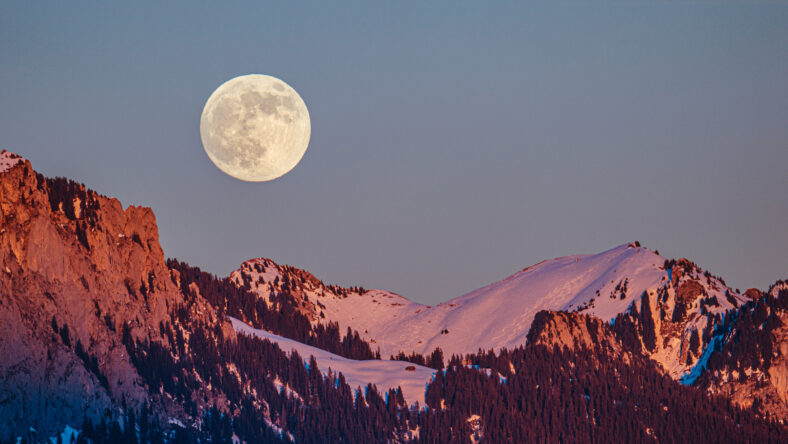
On Sunday, February 1, a full moon known as the “Snow Moon” will rise alongside one of the most beautiful, glittering star clusters in the night sky, giving us a luminous start to a new month.
The Snow Moon is the second full moon of the year and will be at its fullest at 5:09 p.m. EST on February 1, just as evening settles in, making it an especially convenient event to catch without staying up late.
It will be located in the constellation Leo, below the Beehive Cluster, which contains more than 100 stars. The cluster is one of the closest to the solar system at 577 light-years. The moon will be full and bright on the following day as well, extending the viewing window.
The shiniest star in the Leo constellation is called Regulus. It will rise in the eastern sky soon after the full moon. It will be easiest to spot about an hour after the moonrise.
By midnight, Regulus will move up to the left of the Snow Moon. You’ll be able to see the sparkling spectacle without any special instruments, but a pair of binoculars or a small telescope will make it truly shine.
The Snow Moon is named so because February is often the snowiest month of the year. Most of North America gets struck by snowstorms at this time of year. The largest February snow cover in the U.S. was recorded in 1978.
The Snow Moon also goes by a few other names rooted in Native American culture, including the Bear Moon, the Raccoon Moon, the Bald Eagle Moon, the Goose Moon, and the Groundhog Moon.
The Cherokee people refer to it as the Bone Moon and the Hungry Moon because February is considered the harshest stretch of winter, when food supplies ran low, and survival was more difficult.
There are a few reasons why the Snow Moon will be so clear and bright. For one, the Northern Hemisphere is tilted away from the sun during the winter months, so the full moon appears to be suspended higher in the sky than during the summer.
Sign up for Chip Chick’s newsletter and get stories like this delivered to your inbox.
Another reason is that all the snow covering the ground reflects the light that hits it, amplifying a full moon’s glow.
Stargazers won’t have to wait long for the next lunar event. The next full moon to look forward to, the Worm Moon, will rise on March 3. A total lunar eclipse will occur during the Worm Moon’s appearance, making the event extra special.
It will cause the surface of the moon to turn a deep reddish color for 58 minutes in what is known as a “blood moon.” Those in North America, the Pacific, Australia, and East Asia will be able to witness this especially memorable event.

By Emily Chan
Emily Chan is a writer who covers lifestyle and news content. She graduated from Michigan State University with a degree in... More about Emily Chan