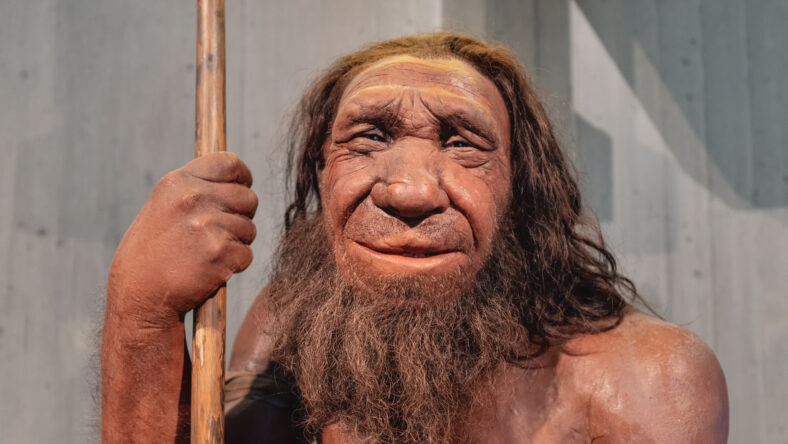
Neanderthals disappeared around 40,000 years ago, and one explanation given for their disappearance is that their brains were different from those of early modern humans (Homo sapiens), who invaded their territory in Eurasia and outcompeted them for resources.
However, a new study of brain variation has revealed that Neanderthals and humans weren’t quite so different after all. Neanderthals did have longer, lower skulls with larger nasal openings and brow ridges, while modern humans have rounder skulls with smaller facial features.
The insides of their skulls are also distinct from each other.
“These shape differences have long been used to suggest Neanderthals differed cognitively from modern humans,” said Tom Schoenemann, the first author of the study and an anthropologist at Indiana University Bloomington.
In the past, experts have assumed that the anatomical differences in the skulls meant that Neanderthals could not talk as well as humans, had limited short-term memory, and had poor planning skills. Now, this theory has been disproven.
The researchers of the new study compared two large MRI datasets of living people to gain a better understanding of brain variation. The two groups included 100 ethnic Han Chinese and 100 Americans with European ancestry.
The research team found that the volume differences between Chinese brains and American brains were larger in nearly 70% of the brain regions they assessed than those previously detected between Neanderthals and early modern humans.
The new finding does not support the idea that Neanderthals had different brains and cognitive abilities than modern humans of the time. It was noted that even small differences in brain size and behavior can affect evolution in a major way.
One of the largest differences between the brains of Neanderthals and Homo sapiens involved attention and inhibition. So, Neanderthals possibly had a lower executive functioning ability.
Sign up for Chip Chick’s newsletter and get stories like this delivered to your inbox.
Still, there is no direct correlation between brain anatomy and cognition. The researchers pointed out that human brains of living populations today are much different than Neanderthal and early modern human brains were from each other.
They do not think that Neanderthals were wiped out due to a lack of intelligence and inability to adapt.
The most likely cause of Neanderthals’ dying out is demography and genetic swamping due to cultural differences. Genetic swamping occurs when the genes of a minority species are overwhelmed by the genes of the majority species.
Since the researchers only compared the brains of Chinese and American people, more research is necessary to confirm their findings.
“It is entirely possible that even larger differences exist among modern human populations, further calling into question the evolutionary significance of the estimated Neanderthal differences in brain anatomy with contemporary anatomically modern H. sapiens,” wrote the research team.
The study was published in the scientific journal PNAS.

By Emily Chan
Emily Chan is a writer who covers lifestyle and news content. She graduated from Michigan State University with a degree in... More about Emily Chan