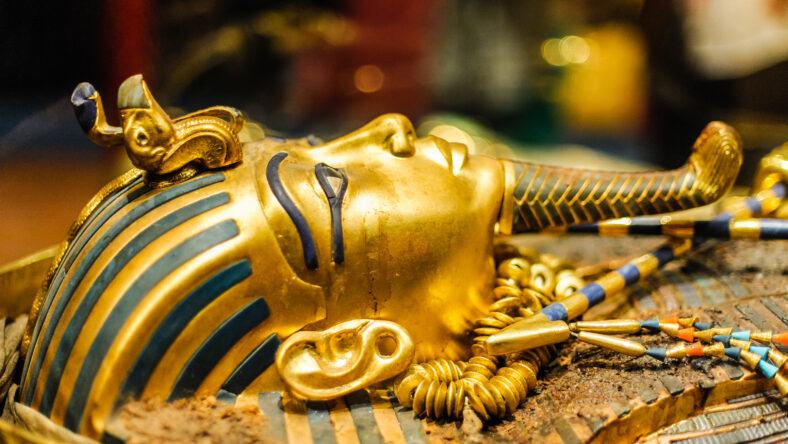
Over a century ago, a British archaeologist named Howard Carter and his team discovered the tomb of Tutankhamun, the boy king of Egypt, in the Valley of the Kings.
Unlike the tombs of other ancient Egyptian pharaohs that have been looted or destroyed by floods, King Tut’s was loaded with treasures that were relatively intact. After excavations were completed, researchers found more than 5,000 artifacts in King Tut’s tomb.
Some of the objects from the collection are widely known, such as his solid gold coffin and funerary mask.
But there are many other smaller items in the tomb that have helped contribute to our knowledge of the young ruler, who died at 19.
Here are five of the less famous but equally fascinating finds that have offered significant insight into King Tut’s life.
Linen Scarf
Which one seems out of place— a gold-plated leopard head, intricate ceremonial objects, or a simple linen scarf?
These are the items that were found in a small fancy wooden chest made from cedar and ebony. When archaeologists unknotted the scarf, they saw that several gold rings were tucked into the folds of the fabric. But why were the scarf and rings in the wooden chest, and how did they get there?
After piecing together some other clues, it became clear that King Tut’s tomb had not been left alone all these years.
Thieves had broken in and taken off with any valuable items small enough to be concealed and carried. The scarf with rings indicated that the thieves were forced to abandon their treasure.
Iron Dagger
King Tut was buried with an iron dagger that was placed near his right thigh. While an iron dagger may seem pretty ordinary, this one was actually quite spectacular.
The pharaoh died centuries before the Iron Age began when mining for iron became commonplace. So, while King Tut was alive, the few iron objects that existed were crafted from meteorites that fell to the earth.
In addition to the iron dagger, King Tut was buried with a gold blade that had an ornately decorated handle.
Board Game
King Tut’s tomb had at least four sets of board games in it, so we can assume that he really loved to play games.
One of his favorites was a game called “senet.” The rules of senet are unclear, but it appears to be similar to checkers.
The game required players to navigate their game pieces through a series of 30 squares. The goal was to prevent your opponent from making it all the way across the board and knocking your piece off.
Undergarments
Clothing was also uncovered in the tomb, and believe it or not, they weren’t all royal robes or the elaborate animal skins typically worn by nobility.
What was left of King Tut’s wardrobe consisted of 100 sandals, a dozen tunics, 28 gloves, 25 head coverings, four socks, and 145 loincloths, which were pieces of linen shaped like triangles that both men and women wore as undergarments.
King Tut’s loincloths were silkier and more well-made than the average underwear. The weave of ordinary Egyptian loincloths had 37 to 60 threads per inch, while King Tut’s had 200 threads per inch.
Lost Daughters
The reign of King Tut was very short, lasting about a decade, and he didn’t leave behind any heirs. But thanks to the discovery of the tomb, archaeologists learned that he had been expecting to be a father at one point.
At the age of 12, King Tut married a woman named Ankhesenamun. She bore two stillborn daughters who were buried in his tomb in two tiny gilded wooden coffins. The mummified remains of the fetuses appeared to be 25 and 37 weeks old. The causes of their deaths are unknown.
Sign up for Chip Chick’s newsletter and get stories like this delivered to your inbox.

By Emily Chan
Emily Chan is a writer who covers lifestyle and news content. She graduated from Michigan State University with a degree in... More about Emily Chan