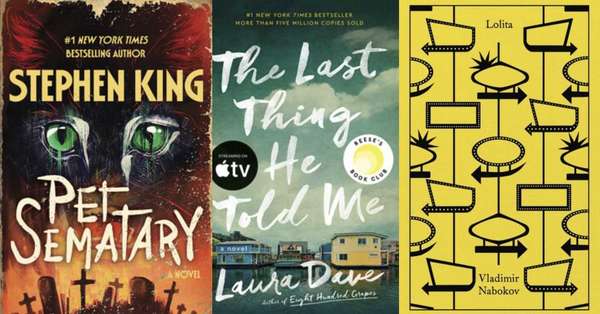
Simon & Schuster, Simon & Schuster, Penguin Random House - pictured above are some of the books deemed most disturbing on Goodreads

Human content, AI powered search.

Sign up for our true crime newsletter and get the cases, confessions and mysteries everyone is talking about.
Not many people knew more about Sir Arthur Conan Doyle and his stories about Sherlock Holmes than Richard Lancelyn Green. He was considered a leading expert on this classic literature. Green's father was a member of The Sherlock Holmes Society of London, so his interest was cultivated at an early age.
In 1965, Green became the youngest member of the society at the age of 12. In adulthood, he became the chairman of the society. He devoted his entire life to the author and the character of Sherlock Holmes. His goal was to create a complete biography of Doyle.
During the 1990s, he struck up a friendship with Jean Conan Doyle, the last surviving child of the British writer. Green eventually discovered that there was a large collection of family documents that had never been seen before. Of course, he was excited to get his hands on them.
He claimed that Jean had made a verbal promise to him that the papers would go to the British Library after her death, but she did not actually have legal ownership or physical access to the papers.
Doyle's heirs fought among themselves. No one could agree about where the papers should end up, resulting in the documents being stored in a vault at a law office in London.
The documents were legally owned by distant relatives of Doyle, who decided to sell the collection in 2004 via Christie's auction house.
When Green learned of the sale, he tried everything to prevent it from happening, citing Jean's final wishes. But ultimately, the collection was auctioned off and scattered.
In the weeks during and after the sale, Green seemed to suffer a nervous breakdown. He claimed that he was receiving threatening phone calls and a "mysterious American" was following him around.
This person was assumed to be Jon Lellenberg, a Holmes expert from the U.S. who used his expertise to help catalog the collection of documents.
 Victor Moussa - stock.adobe.com - illustrative purposes only
Sign up for Chip Chick's newsletter and get stories like this delivered to your inbox.
Over time, Green's behavior grew more and more erratic. He believed that his house was bugged and his phone was tapped, insisting that anyone who needed to speak with him should do so in the garden.
His family and associates were concerned for his well-being. His sister decided to travel to London to check up on him. But when she arrived, she found his dead body. He had been strangled with a shoelace, which was tightened with a wooden spoon.
According to experts, this method of murder, known as garroting, was extremely rare and difficult for suicide. British authorities had only seen one example of it in the 30 years before Green's death. In the end, his death was ruled as a suicide.
No note was left behind, and there were no signs of a struggle or forced entry. There were also reportedly no fingerprints on the wooden spoon.
Green's death mirrored a Sherlock Holmes story titled "The Problem of Thor Bridge." In this story, a character dramatically takes their own life in order to frame a rival for murder.
Before his death, Green was exhibiting signs of mental instability, and he had seemed depressed with the way his life turned out. The only thing he really had going for him was his all-consuming fixation with Sherlock Holmes and Doyle. After Green's death, many of the papers from the collection ended up at the British Library.
The question still stands: did he actually take his own life, or was he murdered?