During World War I, U-boats were one of Germany’s most effective weapons. They snuck up underwater on British ships and launched torpedoes at them. Throughout the war, the U-boats sank more than 5,700 vessels.
To defend themselves from U-boat attacks, the British developed a strategy to help their ships blend into the vast ocean. Norman Wilkinson, a Royal Navy volunteer reserve lieutenant, thought of the idea of covering the ships with bizarre swirls, stripes, and abstract shapes.
The patterns made it more difficult for enemies peering through periscopes to determine a ship’s size, speed, distance, and direction.
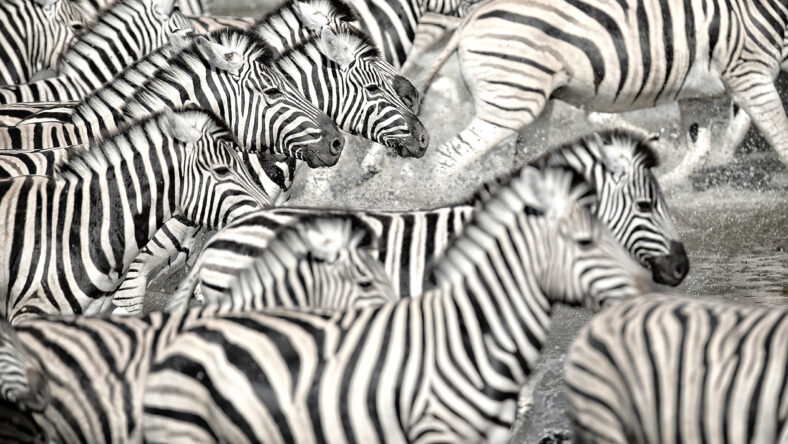
Therefore, it would be harder to destroy ships. The concept came to be known as dazzle camouflage. Interestingly, the name fits perfectly: a group of zebras is also called a dazzle, and their black-and-white stripes serve a similar purpose.
Just as a herd of zebras blurs together in motion, making it hard for predators to single out one target, these painted warships created an optical illusion that confused enemy submarines.
If the dazzle camouflage threw off German calculations even by a few degrees, the torpedoes would miss and save a British ship from being destroyed.
By October 1917, British officials ordered all merchant ships to be painted with dazzle camouflage. A total of 2,300 ships were decorated with dazzle by the end of the war.
It is unclear how much dazzle camouflage actually helped thwart U-boat attacks, but they may not have been as advantageous as previously thought, according to researchers from Aston University and Abertay University. The researchers wanted to find out just how much dazzle camouflage helped in the war effort.
They created a computer model of the ship RMS Mauretania, which was used by the British government as a troop vessel during World War I.
Sign up for Chip Chick’s newsletter and get stories like this delivered to your inbox.
The research team painted it in various dazzle camouflage designs and posed the ship in different directions on computer displays. They asked 16 participants to identify which direction the ship was traveling.
The team found that a texture gradient design in the camouflage pattern gave off the illusion of twisting away from its actual direction.
However, this benefit was diminished by the horizon/hysteresis effect, which is when perceived direction tends to be parallel to the horizon, regardless of camouflage.
This means the twisting dazzle camouflage would sometimes help the ship and sometimes help an attacking submarine, depending on the ship’s true direction.
“If you ask me ‘Did dazzle camo work?’ my answer is yes—but the benefits from perceptual bias would not have been as valuable as the allied WWI navies would have liked,” said Professor Tim Meese from Aston University’s School of Optometry.
Dazzle camouflage has largely fallen out of favor, especially with electronic surveillance and other technology we have today, but in November 2024, Ukraine’s navy shared several images of vessels decorated with a form of dazzle camouflage on social media.
The exact purpose of the dazzle is unclear, but one expert suggested that it could offer some form of protection from drones.
The study was published in Royal Society Open Science.

By Emily Chan
Emily Chan is a writer who covers lifestyle and news content. She graduated from Michigan State University with a degree in... More about Emily Chan