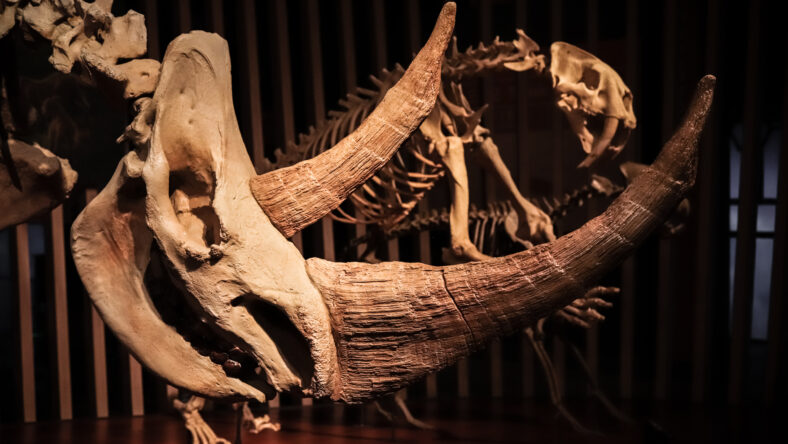
More than a decade ago, the mummified remains of two ancient wolf pups were uncovered from within the Siberian permafrost. A piece of flesh from a woolly rhinoceros was found inside one of the pups’ stomachs.
The DNA from that flesh survived for over 14,000 years. Scientists were able to analyze the entire genome and learn more about the woolly rhino’s extinction.
“This is the first time an entire genome has been reconstructed from an Ice Age animal,” said Camilo Chacón-Duque, a co-author of the study and an evolutionary biologist at Uppsala University in Sweden.
“It’s a high-quality, high-resolution genome.”
The woolly rhinoceros in question was hunted and killed around 14,400 years ago, which was just a few hundred years before the species disappeared from the fossil record altogether. It is by far the youngest woolly rhino to be sequenced.
It has long been debated whether hunters or climate change led to the species’ demise. The new genomic data suggest that the woolly rhino population was healthy up until the end.
About 15 years ago, in 2011, a group of ivory hunters searching for mammoth tusks came across the two wolf pups in Siberia. They are now known as the “Tumat puppies.”
The puppies were both female and likely were from the same litter. They were buried under ice and snow roughly six feet away from each other and shared some DNA characteristics.
They were around nine weeks old when they died. One of the puppies’ last meal was the woolly rhinoceros. The other had eaten a bird and some rhino meat.
Sign up for Chip Chick’s newsletter and get stories like this delivered to your inbox.
Researchers compared the woolly rhino’s muscle tissue to older genomes from 18,000 and 49,000 years ago. They did not detect any signs of inbreeding or mutations that would’ve doomed the population.
The woolly rhino population in northern Siberia was relatively stable and healthy until at least 14,400 years ago. Their extinction must’ve happened rapidly afterward.
A few hundred years after this particular woolly rhino (from the wolf pup’s stomach) died, the Northern Hemisphere began experiencing an abrupt warming period, causing the Ice Age to come to an end.
The warming climate may have eliminated much of the woolly rhino’s food supply and allowed humans to expand into their territory, spreading disease.
“Our results show that the woolly rhinos had a viable population for 15,000 years after the first humans arrived in northeastern Siberia, which suggests that climate warming, rather than human hunting, caused the extinction,” said Love Dalén, a co-author of the study and an evolutionary genomics professor at the Center for Paleogenetics in Sweden.
The new genome does not show the whole picture of the woolly rhino’s extinction, as rare and ancient DNA can be difficult to interpret, but the research still demonstrates that it is possible to recover the DNA of an animal preserved inside another one.
The findings were published in the journal Genome Biology and Evolution.

By Emily Chan
Emily Chan is a writer who covers lifestyle and news content. She graduated from Michigan State University with a degree in... More about Emily Chan