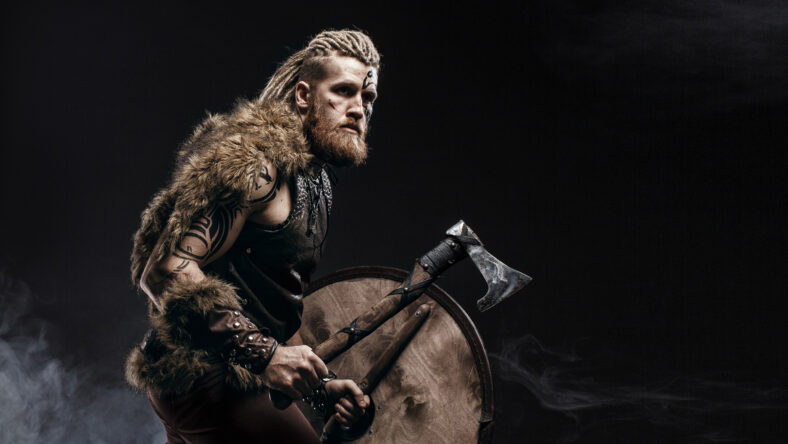
Meet the Jomsvikings, a band of elite Viking warriors who lived by their own code, fought for glory and gold, and never backed down from a battle.
They were active in the 10th and 11th centuries A.D. and stood out from other Viking groups because of their unwavering discipline.
Jomsvikings appear in sagas from the 12th and 13th centuries A.D. One medieval text described the famous Jomsborg, a Danish colony of Norse warriors. It is thought to have been located north of Wolin, a town in Poland.
Since the exact location of Jomsborg is unclear, it is a challenge for historians to learn much about Jomsvikings. Rune stones and passages from Old Norse poetry serve as rare sources of how Jomsborg was founded, although they give different versions of the story.
Some sources claim it was founded after the Danish king Harald Bluetooth gave the conquered settlement of Julinum to the Swedish prince Styrbjörn. Others state that Styrbjörn took the command after the settlement had already been established.
Jomsborg had between 30 and 300 ships in its harbor. Members of the Jomsvikings were between the ages of 18 and 50. They were very exclusive and had to pass different tests that proved their strength and bravery. Many people were rejected by their company.
They followed a set of rules that included avoiding gossip and quarrels, remaining loyal to fellow warriors, avenging each other’s deaths, and dividing up their spoils equally. They were also prohibited from bringing women into the establishment.
When they were not in battle, they could not be away from Jomsburg for more than three nights without permission from their leader. Any violation of the rules would result in strict punishment or even expulsion from the order.
No matter what, they fought as long as they could use their weapons. They only fled if they were vastly outnumbered by the enemy, and even then, they had to do so in an organized manner.
Sign up for Chip Chick’s newsletter and get stories like this delivered to your inbox.
After the Jomsvikings suffered two major defeats in the Battle of the Fyrisvellir and in the Battle of Hjörungavágr (both occurring in the 980s), their power started to fade.
Then, in 1043, King Magnus, the son of King Olaf Haraldsson, burned down Jomsburg and captured some of its inhabitants.
As the Viking Age came to an end in 1066, kingdoms grew stronger, and it became increasingly difficult for independent Viking warrior bands to operate.
So far, archaeological excavations in the area around Wolin have not been able to confirm any stories about the Jomsvikings.
Whether the Jomsvikings were fact or folklore, they inspired courage and loyalty for years. They are even featured in popular culture, such as in Vinland Saga, a series based on a Japanese manga.
Be honest: would you have passed the Jomsvikings’ strength and bravery tests?

By Emily Chan
Emily Chan is a writer who covers lifestyle and news content. She graduated from Michigan State University with a degree in... More about Emily Chan