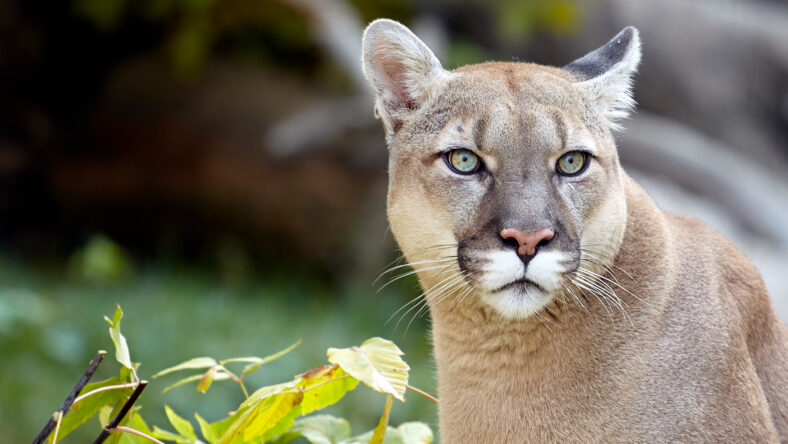
A new study has found that cougars are making slight changes to their diets in order to avoid encounters with wolves. In Yellowstone National Park, cougar and wolf habitats are overlapping more than ever.
Wolves have been stealing prey killed by cougars, causing cougars to adapt their hunting strategies.
Researchers also discovered a pattern of cougars avoiding areas where wolves go hunting and staying near climbable trees. While wolves occasionally killed cougars, cougars did not kill wolves.
Cougars have been shifting toward smaller prey, such as deer, which they can eat faster, reducing the chances of interactions with wolves.
The study draws on nine years of GPS tracking data from collared wolves and cougars, in addition to field investigations of almost 4,000 kill-sites in Yellowstone.
The findings suggest that coexistence between wolves and cougars depends more on the diversity of prey and the availability of escape terrain than on how plentiful the prey is.
“In North America and worldwide, carnivore communities are undergoing major changes,” said Wesley Binder, the lead author of the study and a doctoral student at Oregon State University.
“Our research provides insight into how two apex predators compete, which informs recovery efforts.”
During the 20th century, government policies implemented in the United States to protect livestock nearly pushed wolves and cougars to extinction. In the 1960s and 1970s, cougar populations started to rebound once they were under protection programs.
Sign up for Chip Chick’s newsletter and get stories like this delivered to your inbox.
Wolf reintroduction began in 1995. Now, both of the large carnivores are steadily growing in much of the western U.S., including Yellowstone National Park.
“You’ve had these places that in the last 20, 30 years have had cougars come back, and now wolves are coming back as well,” said Binder.
“There are a lot of people asking questions like, ‘What are our ecological communities going to look like now that we have both of these large carnivores back on the landscape?'”
To learn more about how cougars and wolves coexist, researchers set up 140 remote cameras across the northern part of the park. They also caught cougars and wolves and placed GPS collars on them.
They compared data collected between 1998 and 2005 and data from 2016 to 2024, revealing a major shift in prey choice.
As wolves began to hunt larger prey like bison more frequently, cougars aimed for deer. Over time, both hunted elk less and less. For wolves, elk dropped from 95% to 63% of their diets, while elk saw a decline from 80% to 52% in cougars.
The researchers then used machine learning models to figure out what drives wolf-cougar interactions. They found that nearly half of all encounters took place at sites where cougars made a kill.
They documented 12 cougar deaths, two of which were caused by wolves. The wolves proceeded to eat the elk that the big cats had killed.
On the other hand, none of the 90 recorded wolf deaths that occurred during the same period were caused by cougars. Most were due to natural causes or humans.
The study was published in Proceedings of the National Academy of Sciences.

By Emily Chan
Emily Chan is a writer who covers lifestyle and news content. She graduated from Michigan State University with a degree in... More about Emily Chan