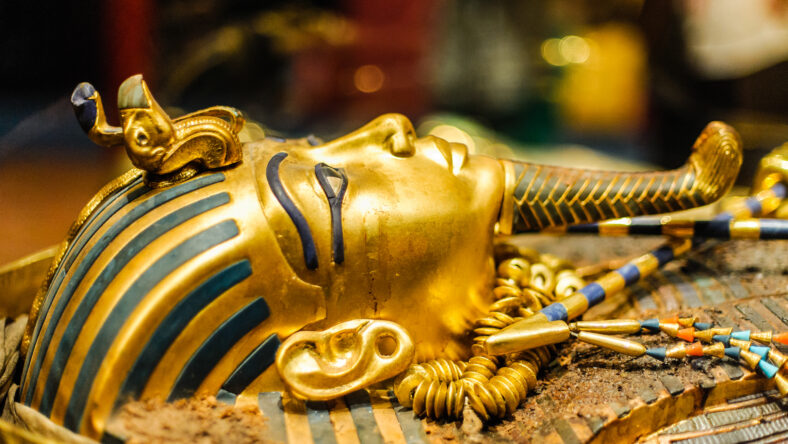
In 1922, King Tutankhamun’s tomb was discovered, revealing much information about the ancient Egyptians. He is the most famous of all the Egyptian kings we know of.
But even today, experts are still trying to make sense of many of the items found in his tomb. For instance, two mummified babies, known as 317a and 317b, were uncovered near his sarcophagus. It’s unclear who these babies were or why they were buried with King Tut.
King Tut was pharaoh for about a decade, from the age of nine to 19. He lived a short life, dying at 19 years old. He left no living children behind.
An archaeologist named Howard Carter and his team cracked open King Tut’s tomb back in 1922. It took 10 years to record 5,398 items, including the pharaoh’s solid gold coffin, thrones, statues, instruments, bows, clothing, food, and wine.
The discoveries helped researchers better understand ancient Egyptian burial rites.
The strangest findings were the bodies of two babies. They were not thoroughly examined until 1932. The tiny bodies were sent to the Cairo Medical University for further study.
A genetic analysis showed that both of the babies were likely stillborn. It is believed that they were the children of King Tut and Ankesanamun, who was also his half-sister.
Due to inbreeding, King Tut’s lineage was rather unhealthy. His own parents had been siblings. King Tut was known to have been born with a cleft palate, a bad foot, and a genetic bone disease.
According to DNA tests, the babies were more than a 99% match with King Tut. They would have been born with birth defects if they had survived. The stillbirths happened around the same time as King Tut’s death.
Sign up for Chip Chick’s newsletter and get stories like this delivered to your inbox.
The fetus labeled as 317a was born prematurely, when the mother was about five or six months pregnant. It was approximately 24.7 weeks old at the time of death.
No eyebrows or eyelashes were present on the body. As for 317b, it was born close to full term, at around 36 weeks.
Experts think the babies were girls, and they were buried alongside King Tut with great care to ensure his passage to the afterlife. They were individually mummified and placed in their own coffins, acting as guards to protect his spirit.
The coffins were engraved with the name Orisis, the Egyptian god of death. The coffins were also wrapped in gold foil, indicating the children’s royal status and the importance of their role in the journey to the afterlife.
King Tut’s daughters are not the only example of mummified fetal remains. Amenhotep II and Thutmose IV were buried with children who died before them as well.
Today, 317a and 317b are in poor condition. When Carter’s team packed them up, they carelessly destroyed their wrappings. But they are currently being conserved to prevent further deterioration.

By Emily Chan
Emily Chan is a writer who covers lifestyle and news content. She graduated from Michigan State University with a degree in... More about Emily Chan