What I’m about to share with you I don’t think is actually about a medical diagnosis; it comes down to the asymmetry of effort in a marriage.
He’s spent a third of his life waiting for his wife to take an active role in managing her PCOS, only to be painted as the problem for finally calling it quits.
This 35-year-old man is in the middle of divorcing his 35-year-old wife, and he is surprised at the lack of sympathy from his loved ones.
He’s been under an immense amount of pressure from them to get back together with his wife, whom he’s been with for a decade, and call off the divorce.
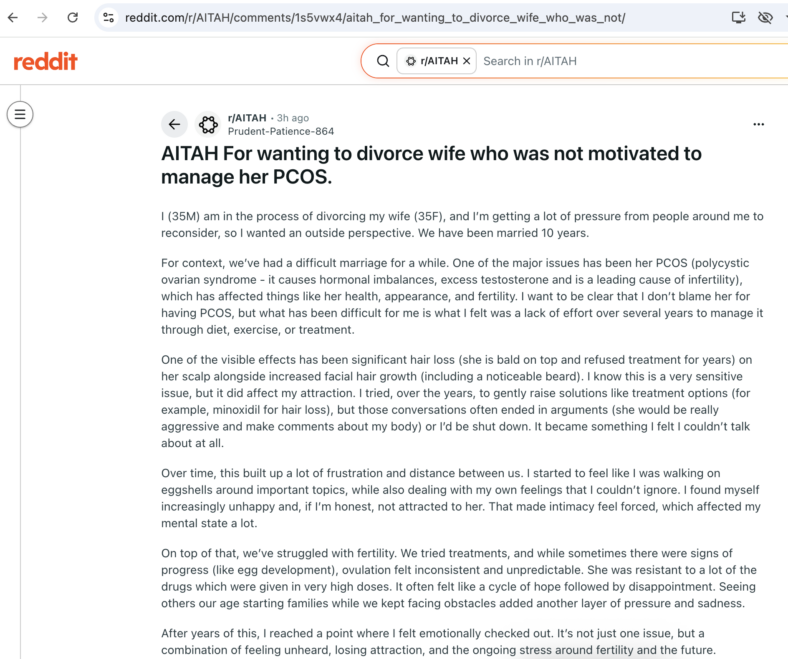
His marriage has been on the rocks for a long time, and it’s mainly due to his wife’s PCOS (polycystic ovarian syndrome), since it has negatively impacted her fertility, her health, and her appearance.
While he doesn’t think it’s his wife’s fault for having PCOS, he’s been struggling with her unwillingness to manage it, which is possible through treatment, diet, and exercise.
“One of the visible effects has been significant hair loss (she is bald on top and refused treatment for years) on her scalp, alongside increased facial hair growth (including a noticeable beard),” he explained.
“I know this is a very sensitive issue, but it did affect my attraction. I tried, over the years, to gently raise solutions like treatment options (for example, minoxidil for hair loss), but those conversations often ended in arguments (she would be really aggressive and make comments about my body) or I’d be shut down.”
“It became something I felt I couldn’t talk about at all. Over time, this built up a lot of frustration and distance between us. I started to feel like I was walking on eggshells around important topics, while also dealing with my own feelings that I couldn’t ignore.”
Sign up for Chip Chick’s newsletter and get stories like this delivered to your inbox.
He grew more miserable and less attracted to his wife in the process. Any physical contact with his wife was something he had to force, and that ruined his mental health.
Additionally, he and his wife have not been successful in trying for a baby. They have undergone multiple treatments and had positive signs, but it never ended up working out.
His wife wasn’t a fan of having to take a lot of medication, given in large doses, in order to participate in the fertility treatments, so he does think it’s her fault.
“It often felt like a cycle of hope followed by disappointment. Seeing others our age starting families while we kept facing obstacles added another layer of pressure and sadness,” he continued.
“After years of this, I reached a point where I felt emotionally checked out. It’s not just one issue, but a combination of feeling unheard, losing attraction, and the ongoing stress around fertility and the future.”
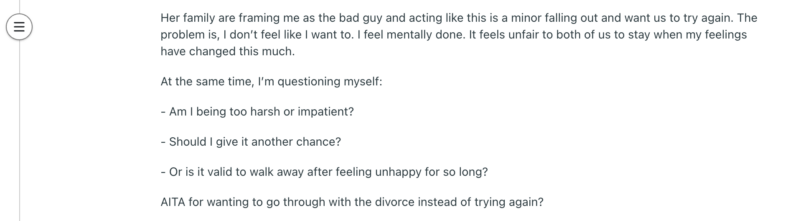
“Her family [is] framing me as the bad guy and acting like this is a minor falling out, and wants us to try again. The problem is, I don’t feel like I want to. I feel mentally done. It feels unfair to both of us to stay when my feelings have changed this much.”
He is starting to doubt himself after his in-laws shared their opinions. He’s worried that he might be too hasty and that his wife deserves to have a second chance.
I’m curious about his wife’s side of the story, and if she is interested in managing her PCOS amid the divorce, but regardless, if he’s not happy in his marriage and he doesn’t love her, he really can’t stay.
It sounds like he has done his best to be supportive, and now it’s time for him to prioritize his own happiness. Regarding the second chance, he’s already given her a lot of time and grace to change. A second chance only works if the person receiving it is willing to do something different.
Do you think he’s doing the right thing with the divorce?
You can read the original post below.

By Bre Avery Zacharski
Hi, I'm Bre, Chip Chick's CEO! I have a degree in Textile/Surface Design from The Fashion Institute of Technology, and... More about Bre Avery Zacharski