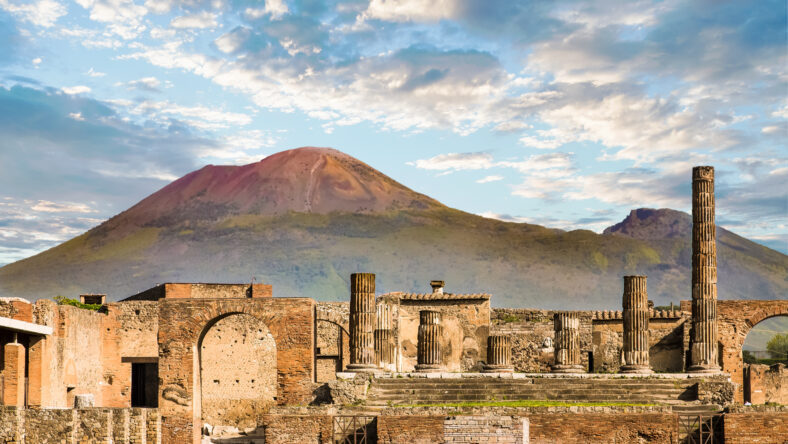
In 79 C.E., Mount Vesuvius erupted and smothered the Roman city of Pompeii with volcanic debris and a heavy cloud of ash and toxic fumes.
One local man attempted to flee toward the coast of what is now Italy, shielding himself by holding a terracotta mortar over his head. He likely perished early in the disaster.
Now, archaeologists have used artificial intelligence for the first time to digitally recreate the face of the man in his final moments. The A.I. reconstruction of the victim was developed in a collaborative effort by the Pompeii Archaeological Park and the University of Padua after his body was excavated from the Porta Stabia necropolis.
Another skeleton belonging to a male was uncovered next to him. The archaeologists believe that both individuals had been trying to get to the beach during the volcanic eruption.
The man from the A.I. reconstruction was older and likely died first on the day of the eruption. He had collapsed near a fractured terracotta mortar that he may have used to protect himself from the lapilli—solidified droplets of lava—that rained down from the volcano.
He was also found with a small iron ring, 10 bronze coins, and a ceramic lamp.
The archaeologists think that he was killed by the lapilli because of the fractures throughout the terracotta mortar. In the A.I.-generated image, the man was shown running along a road covered in debris and holding an object over his head while Mount Vesuvius is erupting behind him.
“Two thousand years later, A.I. is helping us reconstruct his last moments…A.I. does not replace the archaeologist,” said Professor Luciano Floridi of the Digital Ethics Center at Yale.
“Under its control, it expands and deepens his potential and makes accessible to many what was previously accessible only to a few.”
Sign up for Chip Chick’s newsletter and get stories like this delivered to your inbox.
The project aims to use artificial intelligence to make archaeological research more engaging for the public and offer a new perspective on a major catastrophic event in world history.
When Mount Vesuvius erupted in 79 C.E., it spewed an enormous cloud of pumice and ash nine miles into the atmosphere. Ash blocked the sun and fell on the city, followed by volcanic debris.
At nightfall, hot ash and gas spilled over the side of the volcano before another wave of mud and rock poured out.
Not only did the people of Pompeii suffer from the natural disaster, but the nearby town of Herculaneum was also greatly affected. Many people were burned or suffocated to death.
The next morning, a mix of hot gas, lava, and volcanic ash flowed into Pompeii at a speed of up to 200 miles per hour, killing anyone left alive. That was how the second, younger man from the Porta Stabia necropolis died.
Over the years, the destruction of Pompeii has been detailed in books, paintings, operas, and other forms of art. Now, we can add digital portraits to the list.
“If used well, A.I. can contribute to a renewal of classic studies, narrating the classical world in a more immersive way,” said Gabriel Zuchtriegel, the director of the Pompeii Archaeological Park.
[podcast_player episode=”0″]

By Emily Chan
Emily Chan is a writer who covers lifestyle and news content. She graduated from Michigan State University with a degree in... More about Emily Chan