Love is supposed to be able to conquer all. It’s an anchor, a force capable of weathering any storm. Love is meant to be our ultimate source of resilience; the light that keeps us secure when the world goes dark. If you love someone enough, you’ll have the grit and grace to handle anything life throws your way…or will you?
Is love alone enough to help us navigate our spouse transitioning from one gender to another? Is love capable of seeing us through accepting the person we signed up to spend the rest of our lives with, becoming someone else entirely?
This 32-year-old woman met her husband right before the start of the pandemic. She wasn’t looking for a committed relationship, and he wasn’t seeking one either.
Her husband had just gotten dumped by a long-standing girlfriend, and she was recovering from a super toxic relationship. But it felt like fate when she formed an instant bond with him.
It was as if they had known one another forever. It only took a few weeks for them to fall head over heels in love. Their family members and friends were worried it was a rebound, but they knew better.
“…We were absolutely perfect for one another. Even strangers on the street would make comments about how perfect we were together,” she explained.
“He was gentle, kind, patient, funny, intelligent, and deeply compassionate. We fit into each other’s lives so well, [as if] it has always been that way. Even our arguments worked; we were never cruel, never combative, and it felt like we were working together to solve a problem. I had never experienced that before.”
“The one thing about my partner was that he always had this deep undercurrent of sadness, even in our happiest moments. There was always this note of melancholy. I thought it was due to a painful childhood and [his] diagnosed chronic depression.”
He would make dark, upsetting remarks, such as he didn’t anticipate living to see his 40th birthday. She didn’t think he was being serious because he had the personality of a moody rockstar.
Sign up for Chip Chick’s newsletter and get stories like this delivered to your inbox.
They lived together in a city throughout lockdown, and when it was over, they relocated to the country and kissed urban life goodbye. Everything was blissful.
Five years into dating, they got engaged, and they were so thrilled that they booked their wedding venue before her husband even got down on one knee.
She loved planning her wedding, and she thought her husband was the man of her dreams. Nothing could make her life sweeter than it was.
Exactly 102 days before they were set to walk down the aisle, her husband shocked her by coming out as trans (small note here – she said she was referring to her husband as he/him for clarity, and I’m going to keep doing that for the same reason, not to be disrespectful).
He swore that it had only just dawned on him, and he couldn’t tie the knot with her unless he said something about his true identity.
She was blindsided, but she told him that she loved him regardless. And love should be enough to conquer all.
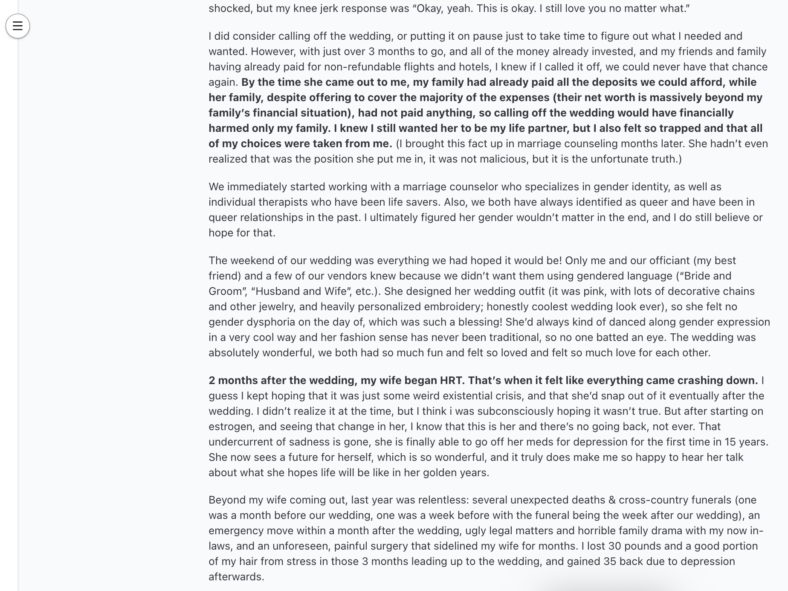
“I did consider calling off the wedding, or putting it on pause, just to take time to figure out what I needed and wanted. However, with just over 3 months to go, and all of the money already invested, and my friends and family having already paid for non-refundable flights and hotels, I knew if I called it off, we could never have that chance again,” she said.
Also, her family had shelled out every last dime to cover the wedding deposits, and they couldn’t afford to lose that cash if she backed out.
She did feel pressured to put on that wedding dress, and like she didn’t have a say in the matter due to all the external influences.
Later on in marriage counseling, she addressed this with her husband, who had no clue he had forced her into that position. He wasn’t trying to be mean; he was trying to be authentic.
And speaking of counseling, they jumped into that. They also found separate therapists as well to help them work through her husband’s transition from male to female.
Since she and her husband had been in same gender relationships before meeting one another, she genuinely thought she could come to accept her husband’s new gender in time.
“I ultimately figured her gender wouldn’t matter in the end, and I do still believe or hope for that. The weekend of our wedding was everything we had hoped it would be!” she exclaimed.
Her officiant (who doubles as her bestie) and a handful of vendors were privy to her not wanting any gender specific language referring to them as the bride and groom, and her husband made a pink wedding ensemble, which nobody found strange since he’s always had interesting fashion taste.
Her wedding was so amazing that she thought she could handle her new normal. But two months later, her husband started hormone replacement therapy to officially kick off the transition, and sat there hoping it was a bizarre personality crisis he would snap out of.
She desperately wanted this not to be true. She wanted her husband, not a wife. After her husband went on estrogen and she noticed some feminine changes, it hit her that there was no pressing rewind.
Her husband is no longer on depression medication, something he’s been taking for the last 15 years, and he quit being so deeply saddened. She does think these changes are worth applauding.
As if dealing with her husband’s transition wasn’t enough, she had a couple of sudden deaths in her family, and had to travel to the other side of the country for the funerals. Then, she had to move a month before her wedding because it was an emergency, she had a horrendous legal battle with her in-laws, and her husband needed to have an excruciating surgery that he spent months recovering from.
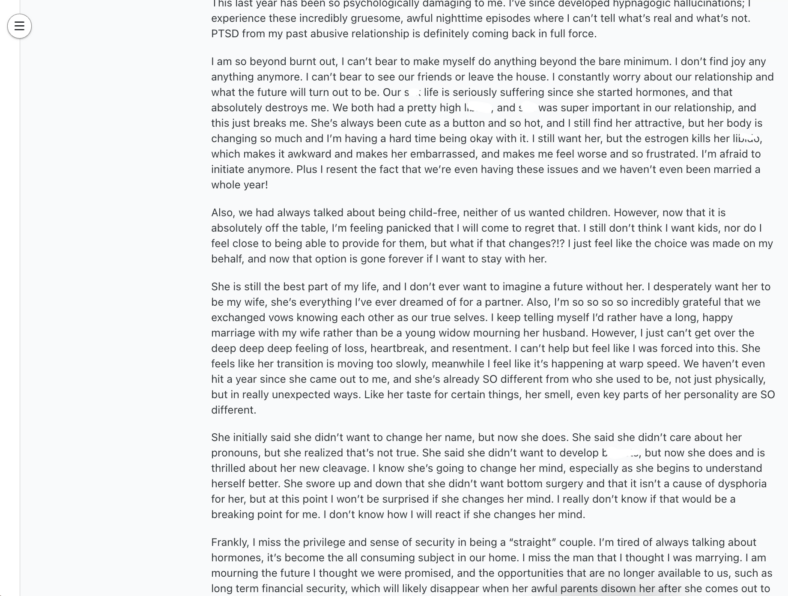
The universe threw her more than she could handle, and her hair fell out. She lost 30 pounds, too, only to put 35 back on because she spiraled into a depression. She’s experiencing hypnagogic hallucinations, and she can’t tell at night what’s real and what she’s imagining. She’s burnt out, no longer finds joy in things, and doesn’t want to leave her house.
She and her husband have a dead bedroom, because his body has gone through so many changes that she doesn’t like. She hates that this is happening when they haven’t been married for a year yet.
“Also, we had always talked about being child-free; neither of us wanted children. However, now that it is absolutely off the table, I’m feeling panicked that I will come to regret that,” she added.
“I still don’t think I want kids, nor do I feel close to being able to provide for them, but what if that changes?!? I just feel like the choice was made on my behalf, and now that option is gone forever if I want to stay…”
Despite all of this, her husband is still the highlight of her life. She wants to make him her wife, but she’s resentful, heartbroken, and grieving. Her husband’s personality and taste have changed, and he smells different.
The changes are coming at a breakneck pace, as even though her husband said he wouldn’t change his name to a feminine one, he changed his mind.
He also said he wasn’t concerned with pronouns, but he is. He said he didn’t want a chest, but he’s over the moon about the cleavage he’s developed.
He said he didn’t want bottom surgery, but she’s afraid he’s going to do that too, and it might just be the final straw for her.
“Frankly, I miss the privilege and sense of security in being a ‘straight’ couple. I’m tired of always talking about hormones; it’s become the all-consuming subject in our home,” she continued.
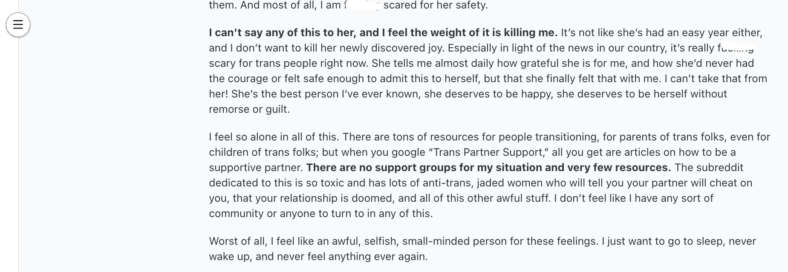
“I miss the man that I thought I was marrying. I am mourning the future I thought we were promised, and the opportunities that are no longer available to us, such as long-term financial security, which will likely disappear when her awful parents disown her after she comes out to them. And most of all, I am…scared for her safety.”
She keeps her concerns inside, afraid to say anything, and it makes her feel so selfish.
I think it’s possible for her to still have love for her husband, but choose to walk away from their marriage since it’s not what she wants or what she envisioned, and that’s ok. There’s no longer an element of romance or attraction for her.
Sure, the love she has for her husband is different and not romantic, and he can still be in her life, but perhaps as a friend now instead. I think she’s feeling guilty for loving him, but seeing that she’s unable to stay with him.
That doesn’t make her a bad person, because she signed up for one thing and got the complete opposite. And her husband isn’t a bad person either for transitioning and living his truth.
What advice do you have for her? Do you think she should stick this out? Is it possible to love the person your spouse is becoming while still profoundly grieving the person they were?
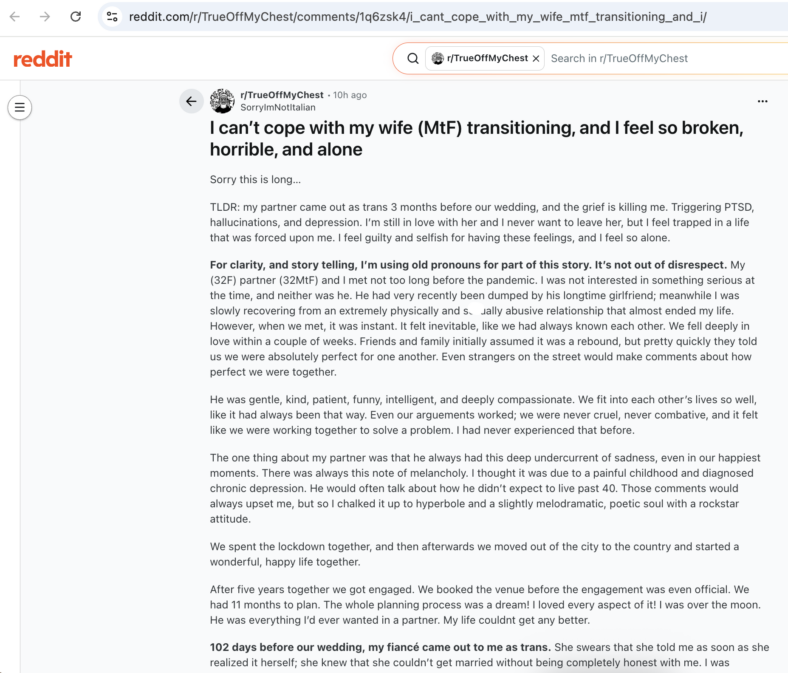
You can read the original post below.

By Bre Avery Zacharski
Hi, I'm Bre, Chip Chick's CEO! I have a degree in Textile/Surface Design from The Fashion Institute of Technology, and... More about Bre Avery Zacharski