It can be agonizingly brutal to finally have the smoking gun of a spouse’s betrayal, only to be told you aren’t allowed to use it. For a lot of people, being the wronged party in a relationship is a form of armor; it’s the one thing that feels like proof that you weren’t the problem.
But she’s finding out that holding onto that moral high ground is a lot like holding onto a hot coal: she’s the only one getting burned while she waits for her husband to hurt.
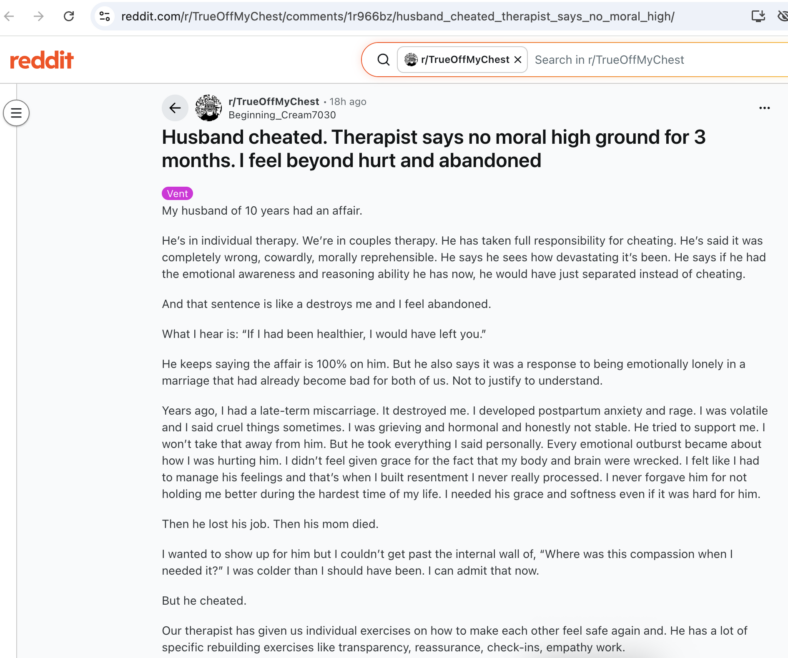
This woman has been with her husband for a decade, and he recently cheated on her. They are currently in couples therapy to try to fix their marriage.
“He has taken full responsibility for cheating. He’s said it was completely wrong, cowardly, [and] morally reprehensible,” she explained.
“He says he sees how devastating it’s been. He says if he had the emotional awareness and reasoning ability he has now, he would have just separated instead of cheating.”
“And that sentence is like [it] destroys me, and I feel abandoned. What I hear is: ‘If I had been healthier, I would have left you.’ He keeps saying the affair is 100% on him. But he also says it was a response to being emotionally lonely in a marriage that had already become bad for both of us.”
Her husband isn’t using this as a justification or an out on accountability; he told her this as a means of trying to find the root cause of his infidelity.
Several years ago, she suffered from a late-term miscarriage, and it devastated her. She became explosive and was diagnosed with postpartum rage and anxiety.
Often, she said savage and brutal things to her husband because she was unstable and drowning in her grief. Her husband did his best to be supportive, and she can’t deny that, but he took her words personally.
Sign up for Chip Chick’s newsletter and get stories like this delivered to your inbox.
When she did have outbursts, her husband turned them into how she was causing him pain. She didn’t think he gave her the room to deal with feel ruined.
“I felt like I had to manage his feelings, and that’s when I built resentment I never really processed. I never forgave him for not holding me better during the hardest time of my life. I needed his grace and softness, even if it was hard for him,” she added.
“Then he lost his job. Then his mom died. I wanted to show up for him, but I couldn’t get past the internal wall of, ‘Where was this compassion when I needed it?’ I was colder than I should have been. I can admit that now.”
“But he cheated. Our therapist has given us individual exercises on how to make each other feel safe again. He has a lot of specific rebuilding exercises like transparency, reassurance, check-ins, [and] empathy work.”
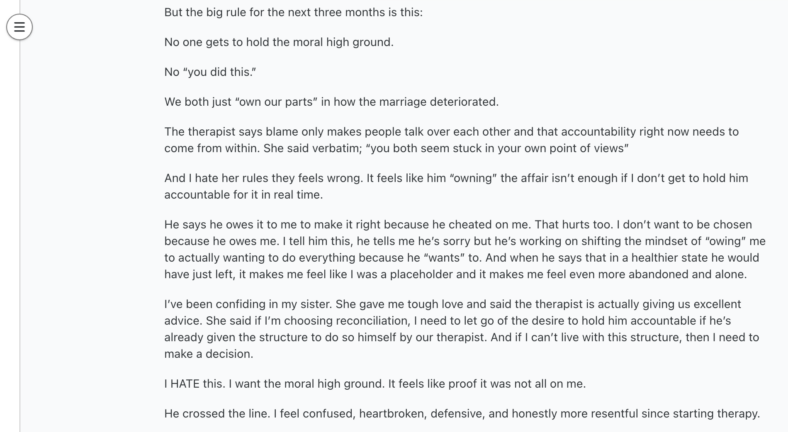
The biggest rule their therapist gave them to stick to is that for three months in a row, she and her husband are not allowed to point the finger and blame the other person for anything.
Their therapist says they both need to own the roles that they played in the breakdown of their marriage, since they’re both culpable.
Their therapist also feels they are incredibly stuck on their points of view. Their therapist’s rule of not being allowed to take the moral highground feels wrong to her, which she hates.
“It feels like him ‘owning’ the affair isn’t enough if I don’t get to hold him accountable for it in real time. He says he owes it to me to make it right because he cheated on me,” she continued.
“That hurts too. I don’t want to be chosen because he owes me. I tell him this, he tells me he’s sorry, but he’s working on shifting the mindset of ‘owing’ me to actually wanting to do everything because he ‘wants’ to.”
“And when he says that in a healthier state, he would have just left, it makes me feel like I was a placeholder, and it makes me feel even more abandoned and alone.”
She’s been relaying what goes down in the therapy sessions to her sister, who believes their therapist is doling out incredible advice she needs to listen to.
Her sister is pushing her to quit trying to force accountability on her husband since she has chosen to reconcile with him, and therapy is giving her husband the ability to move on.
Her sister strongly feels that if she doesn’t like the structure their therapist is giving her husband to do the hard work, she has one tough choice to make. Perhaps reconciliation isn’t for her.
“I HATE this. I want the moral high ground. It feels like proof [that] it was not all on me. He crossed the line. I feel confused, heartbroken, defensive, and honestly more resentful since starting therapy,” she concluded.
I think she’s still stuck on trying to punish her husband and make him suffer; she doesn’t have the right mindset for fixing her marriage, since she’s not truly attempting to move on and heal.
It also doesn’t come across like she’s owning the mistakes she made and what she did to cause the demise of her marriage, and that’s not healthy.
To me, it looks like being married is no longer in her best interests since this is not something she can put behind her. She still is hanging onto the hurt.
What advice do you have for her? Do you think it seems like she’s backing out on reconciliation?
You can read the original post below.

By Bre Avery Zacharski
Hi, I'm Bre, Chip Chick's CEO! I have a degree in Textile/Surface Design from The Fashion Institute of Technology, and... More about Bre Avery Zacharski