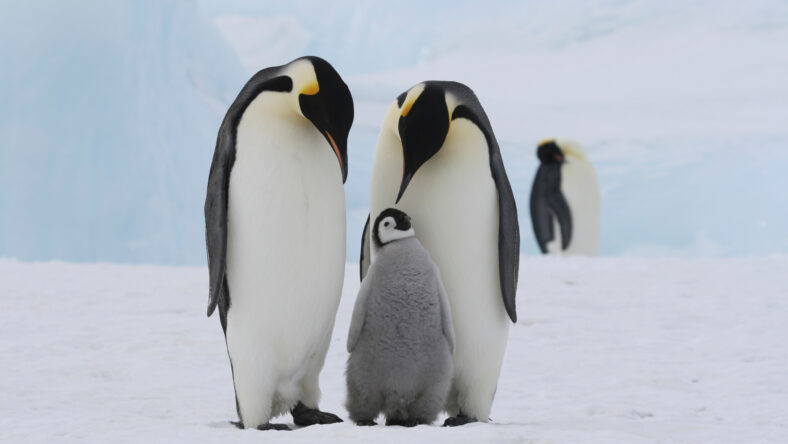
By the 2080s, the emperor penguin population could be cut in half, according to the International Union for Conservation of Nature (IUCN).
Emperor penguins are now considered an endangered species due to human-caused global warming. Their Antarctic habitat is melting away, which will decrease their chances of survival and success in breeding.
Emperor penguins replace their waterproof feathers every year during their catastrophic molt. The process takes about 30 to 40 days.
During this time, the penguins must stay out of the water because without their feathers, the frigid temperatures could kill them.
“They’re not bald like a plucked chicken—their new feathers push out the old feathers—but they’re not waterproof at this stage,” said Peter Fretwell, an author of the study and a geographic and remote sensing scientist with the British Antarctic Survey.
“And that means that if the ice breaks out from under them while they’re molting, they go into the water without their ‘wetsuits,’ as it were, and they will become hypothermic and could die.”
The birds’ primary habitat is sea ice, and in recent years, sea ice has become more and more unstable. For example, around 7,000 emperor penguin chicks perished in 2022 because of unstable sea ice.
Chicks have fluffy down feathers that aren’t waterproof, so if they make their way into the ocean too soon, they may die of hypothermia or drown because they can’t swim yet.
The IUCN estimates that 20,000 adult emperor penguins died between 2009 and 2018, which is about 10% of the birds’ population.
Sign up for Chip Chick’s newsletter and get stories like this delivered to your inbox.
Scientists predict that emperor penguins will be mostly extinct by the year 2100. They use satellite imagery to monitor the birds.
Emperor penguins aren’t the only Antarctic species suffering from global warming. Per the IUCN, the Antarctic fur seal’s status has shifted from “least concern” to “endangered.”
Within three decades, the seal’s population has declined by more than 50%. In 2025, only 944,000 individuals exist compared to about 2,187,000 in 1999.
The southern elephant seal is also now considered vulnerable because of avian influenza. Many adult females and newborn pups are being wiped out due to H5N1 bird flu.
As ocean temperatures rise and sea ice cover shrinks, semiaquatic animals are having a hard time feeding themselves. Their main food source, krill, is being affected. Krill is being forced deeper into the ocean in search of colder water, reducing the availability of food.
“These listings are not only sobering for two iconic animals; they reflect what is happening to penguins and seals globally,” said Dr. Kathleen Flower, vice president of biodiversity science at Conservation International.
“Their decline underscores how quickly ecosystems are being degraded and how the compounding impacts of warming accelerate food scarcity, emerging disease, and habitat loss. The result is rapidly increasing extinction risk for many species.”

By Emily Chan
Emily Chan is a writer who covers lifestyle and news content. She graduated from Michigan State University with a degree in... More about Emily Chan