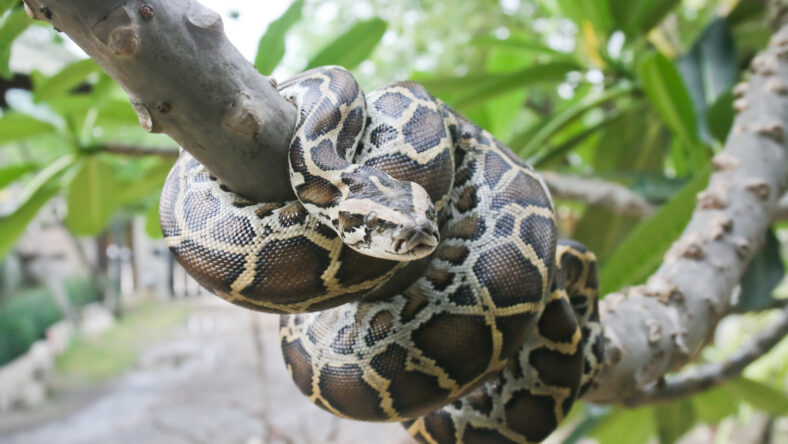
For decades, the state of Florida has faced a python problem. Burmese pythons were introduced into the Everglades through the exotic pet trade in the 1970s.
According to the U.S. Geological Survey, the first wild Burmese python in South Florida was documented in Everglades National Park in 1979.
Ever since then, the snakes have established a permanent breeding population, brought in harmful non-native parasites, and crippled native animal populations. The number of raccoons in the state has decreased by 99%, opossums by 98%, and bobcats by 88%.
Burmese pythons can grow up to 20 feet long, and they thrive in tropical wetlands, so reducing their numbers has been something of a challenge. Humans cannot easily traipse through the marshland to eradicate pythons one by one.
The longest Burmese python ever captured in Florida was recorded in July 2023, and it was more than 19 feet long, per the Florida Fish and Wildlife Conservation Commission.
The heaviest python in Florida was caught in 2022 in Naples by a biologist at the Conservancy of Southwest Florida. It weighed 215 pounds and was 18 feet long.
In the past, experts have tried using robotic rabbits to hunt the pythons, but the strategy was unsuccessful. Now, scientists are using a new approach to fight the invasive pythons.
Opossums are one of the pythons’ favorite prey, so a select few will be fitted with small GPS-tracking collars and released into areas where the snakes are known to hunt.
When a python eats a collared opossum whole, it will swallow the GPS collar. The tracking device will keep emitting a signal, allowing researchers to locate the python, euthanize it, and remove it.
Sign up for Chip Chick’s newsletter and get stories like this delivered to your inbox.
Wildlife biologists from the North Carolina Museum of Natural Sciences unintentionally came up with the plan in 2022 after traveling to Florida and fitting opossums with expensive tracking collars. Each one costs about $1,500.
Soon enough, the local pythons kept eating the opossums they were using for their study. Eventually, the researchers figured out an effective way to use opossums as python bait.
The opossums will wear cheaper collars that cost $190 each. The researchers will enlist at least 40 opossums and will use Crocodile Lake National Wildlife Refuge in Key Largo for their experiment.
“We’re not putting these animals out there and in harm’s way,” said Jeremy Dixon, a manager at Crocodile Lake National Wildlife Refuge.
“Harm’s way is there. We’re just documenting what’s happening.”
In other words, they are not sending opossums to their deaths. It’s an unavoidable fact that some opossums will come across a python’s path and be sacrificed as part of the food chain. But their demise will benefit science greatly as conservationists continue trying to restore the Florida ecosystem.
Hopefully, the GPS-collar program will allow researchers to locate pythons more quickly and remove them before they spread deeper into Florida.

By Emily Chan
Emily Chan is a writer who covers lifestyle and news content. She graduated from Michigan State University with a degree in... More about Emily Chan