Maria stock.adobe.com - illustrative purposes only, not the actual person - pictured above is a a boy on the shore

Human content, AI powered search.

Sign up for our lifestyle newsletter: relationships, romance and real stories, straight to your inbox.
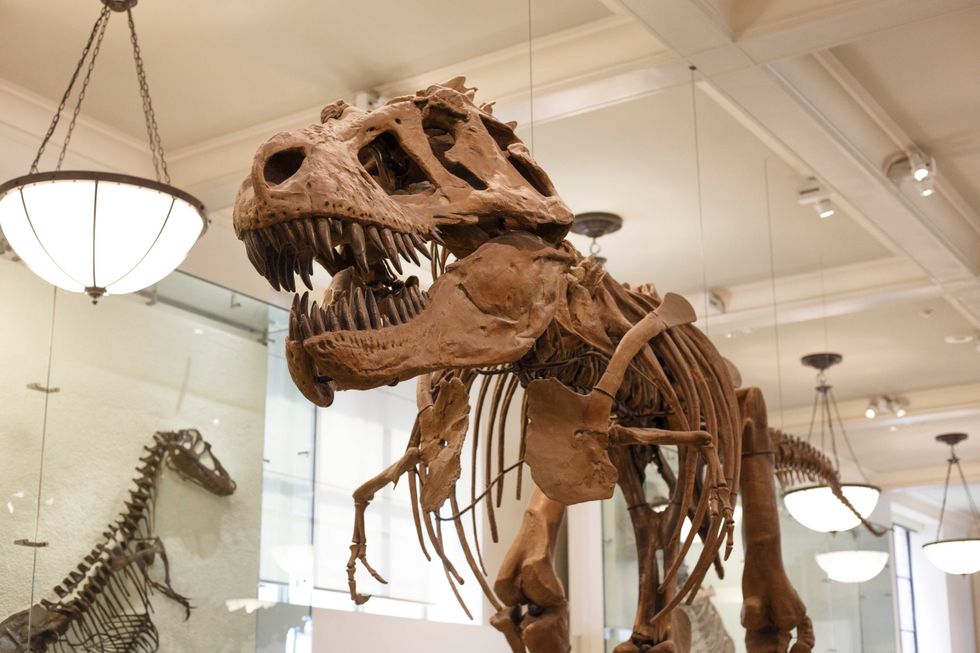
Tyrannosaurus Rex was the apex predator of the Late Cretaceous world. You might picture these dinosaurs stomping around on two giant feet, but they actually might have tiptoed everywhere instead, according to new research.
Researchers analyzed fossilized footprints and leg features of four well-preserved T. rex skeletons from museums across the United States to figure out the extinct animals' gait, speed, and how their feet struck the ground.
The research team, led by the College of the Atlantic in Maine, started by measuring the leg and foot bones and plugging the numbers into three equations used to estimate animal speeds.
Then, they created three different models of how the foot could have hit the ground and compared the models to data from ostriches and humans.
They discovered that T. rex most likely hit the ground with toes first in quick strides to reduce contact with the ground, travel faster, and maintain balance on uneven terrain.
The tiptoe steps made the dinosaur's legs act as shock absorbers so they could bear their own weight and stay balanced.
According to Steve Brusatte, a paleontologist at the University of Edinburgh in Scotland who was not involved in the study, the T. rex would have been "something like an eight-ton chicken clucking about in the barnyard."
Moving on tiptoes allowed the dinosaur to take more steps in less time. A flat-footed T. rex would have been significantly slower. A tiptoeing T. rex could reach speeds of about 11 to 25 miles per hour.
Different-sized T. rexes also would have moved at different speeds. Young, small dinosaurs may have run up to 37 feet per second, while adults were slower, at up to 20 feet per second.
 REC and ROLL - stock.adobe.com - illustrative purposes only
Sign up for Chip Chick's newsletter and get stories like this delivered to your inbox.
"Our study represents, to our knowledge, the first quantitative biochemical analysis of the effects of foot-strike patterns on the gait of Tyrannosaurus. We find that the pes [the foot] of T. rex functioned similarly to the foot of a bird," wrote the researchers.
So, these massive creatures had a very bird-like gait, similar to the movements of modern ground birds. Overall, the findings of the study suggest that the dinosaurs hunted different prey during certain stages of life.
The younger, faster T. rexes probably chased after smaller, speedier animals. The slower adults likely hunted bigger, sluggish prey.
The new findings could not have been gleaned from just examining fossilized bones. It is now even more clear that T. rex and modern birds are linked through evolution.
In order to learn more about T. rex, it is crucial to understand how early birds developed. Now, the T. rex might have to be portrayed a little differently in dinosaur movies!
The results of the study were published in the journal Royal Society Open Science.