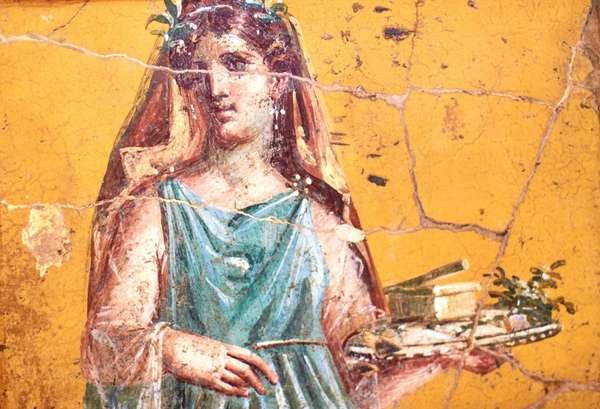
BlackMac - stock.adobe.com - illustrative purposes only, not the actual person - pictured above is a woman painted in a fresco of a domus in Pompeii

Human content, AI powered search.

Sign up for our lifestyle newsletter: relationships, romance and real stories, straight to your inbox.
Via dell'Abbondanza (which means, quite literally, "Street of Abundance") was once one of the busiest places in Pompeii. Stores there sold oil, bread, wine, and even prepared foods before the eruption of Mount Vesuvius covered it all with ash in 79 CE.
It was nearly 2,000 years ago that a woman who lived on that very street closed her wooden wardrobe in the House of Cornelius Maximus, also known as House IX 11, 7, for the last time.
She may have been trying to outrun the eruption, as she left behind considerable valuables and never returned home to get them.
The wardrobe kept her secrets closed inside until they were recently uncovered, and those objects she owned paint an interesting picture of what her life back then was like.
"The memory of a lifetime, locked away in a cabinet that was never reopened, has now been brought to light in Pompeii thanks to the work of archaeologists," the Archaeological Park of Pompeii explained in a press release.
Tweezers, a tiny pestle she used to mix up her makeup, a perfume bottle, and an incense burner to make sure her house was filled with fragrance were inside the wardrobe.
"Furthermore, bronze, glass, and ceramic vases and pots: everyday objects, but perhaps also laden with memories, as in the case of an elegant jug decorated with pine cone flakes," the Archaeological Park of Pompeii added.
The most intimate belonging inside, though, was a necklace that contained 24 little charms made of glass paste, bone, rock crystal, and faience (a tin-glazed ceramic).
The charms portrayed bunches of grapes, feet and hands, pine cones, and tiny gods, including Mercury and Bes. Mercury was a major player in Roman mythology, the god of financial gain, commerce, luck, communication, and travelers. He also guided souls to the afterlife.
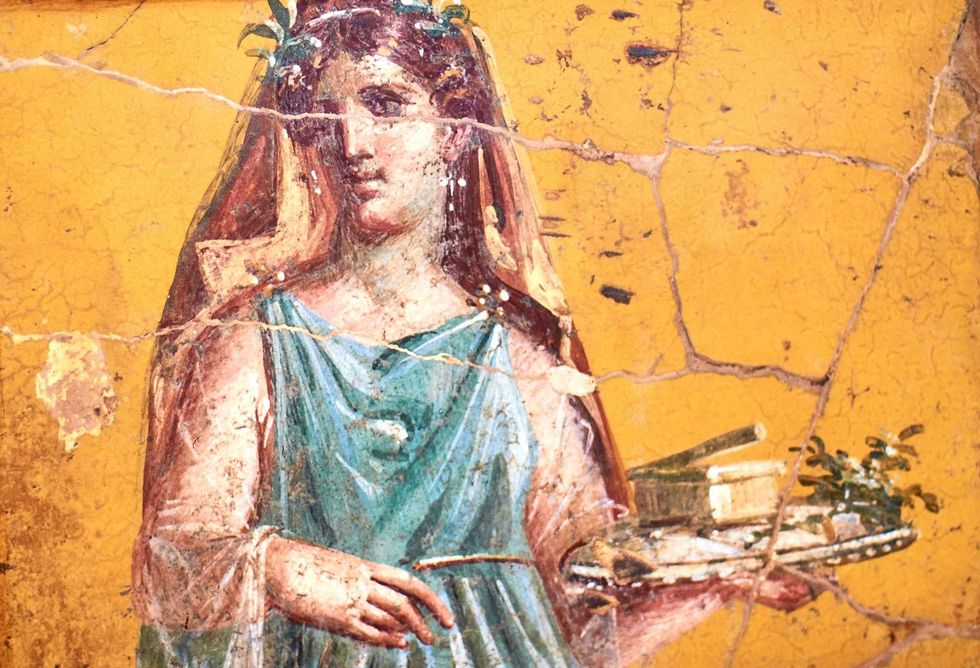 BlackMac - stock.adobe.com - illustrative purposes only, not the actual person - pictured above is a woman painted in a fresco of a domus in Pompeii
Bes was an ancient Egyptian god who was popular in the Roman Empire; a household protector who guarded homes against evil spirits and watched over pregnant women and newborns.
Necklaces like hers were called crepundia, which means "rattles" in Latin. Roman moms and dads gifted these necklaces to their kids for protection as well as identification.
The charms were chosen because they were meaningful and special to parents, and they later became keepsakes for those kids who grew up.
"Adults also sometimes kept them, often in small boxes or, as in this case, in cloth bags inside wardrobes, evidently as mementos of a childhood of which little else sometimes remained: the Roman world was characterized by high geographic mobility at all levels, from slaves to wealthy merchants, so many people found themselves living far from relatives and parents and the places of their childhood," the Archaeological Park of Pompeii revealed.
38 bronze coins and a little woven container called a cistella were also discovered alongside the necklace. The coins point to there having been no time for the homeowners to take valuables from their dwelling.
"If they were in the city at the time of the catastrophe, they would have attempted to escape; similarly, if they managed to escape, they would never have returned to dig underground for their belongings, like others whose traces have been revealed by recent excavations," the Archaeological Park of Pompeii said.
"But perhaps they didn't make it, and they could be among those who, as the historian Tacitus recalls, died without an heir, and whose assets were supposedly used for the refoundation of Pompeii, which ultimately never materialized. These are questions destined to remain open."
The last findings from the wardrobe were two field mouse skeletons, 117 fragments that revealed the mice were not yet full-grown. Just like in modern times, these pesky rodents made their way into houses, looking for food.
"This discovery adds to evidence of rodent presence in other Vesuvian contexts, such as in the servants' quarters of the suburban villa of Civita Giuliana or in the sewers of Herculaneum, and paints a picture of an urban society that also contended with unwelcome guests," the Archaeological Park of Pompeii continued.
How cool is that?
You can see photos of what was inside the wooden wardrobe here.